Global Construction Equipment Aftermarket: A $54.3 Billion Maintenance Market
The real business starts once the equipment is sold. A report released by Global Market Insights in August 2026 puts the global construction equipment repair and maintenance market at USD 36.1 billion in 2025, rising to USD 37.3 billion in 2026 and reaching USD 54.3 billion by 2035, a compound annual growth rate of 4.3% for 2026-2035. Almost concurrently, Jiemian News posed another question in its September 23 report: Chinese heavy equipment has been sold all over the world - but who keeps those machines running?
On one side, the installed base keeps growing and needs ever more repairs; on the other, overseas service networks cannot keep up. The gap between the two is precisely the space the aftermarket occupies. For equipment owners, rental houses and buyers preparing to go overseas, the aftermarket is not industry news - it is a ledger that directly determines downtime and operating costs.
How Large Is the Aftermarket: $36.1 Billion Heading to $54.3 Billion
Start with the global picture. On GMI's accounting, the global construction equipment repair and maintenance market totaled USD 36.1 billion in 2025, with Asia-Pacific both the largest market and the fastest-growing region. Future Market Insights, using a different methodology, is more conservative: USD 24.1 billion in 2025 and USD 35.9 billion in 2035, a CAGR of 4.1%. The two reports differ in absolute terms but agree on direction: aftermarket growth is holding above 4%, far steadier than the volatility of complete-machine sales over the same period.

Two fundamentals underpin this market. First, machines are getting older. The average age of heavy earthmoving equipment in North America and Western Europe has reached 8-11 years, and repair frequency rises markedly once machines fall out of warranty. Second, machines are worked harder. Infrastructure investment pushes up equipment utilization, preventive maintenance intervals are compressed, and wear-related repair volume climbs in turn. The spread of telematics and IoT has also turned "fix it when it breaks" into "fix it based on the data": remote diagnostics and condition-based maintenance are becoming standard fixtures in service contracts.
Who Is Slicing the Pie: The Top 5 Hold Just 29.6%
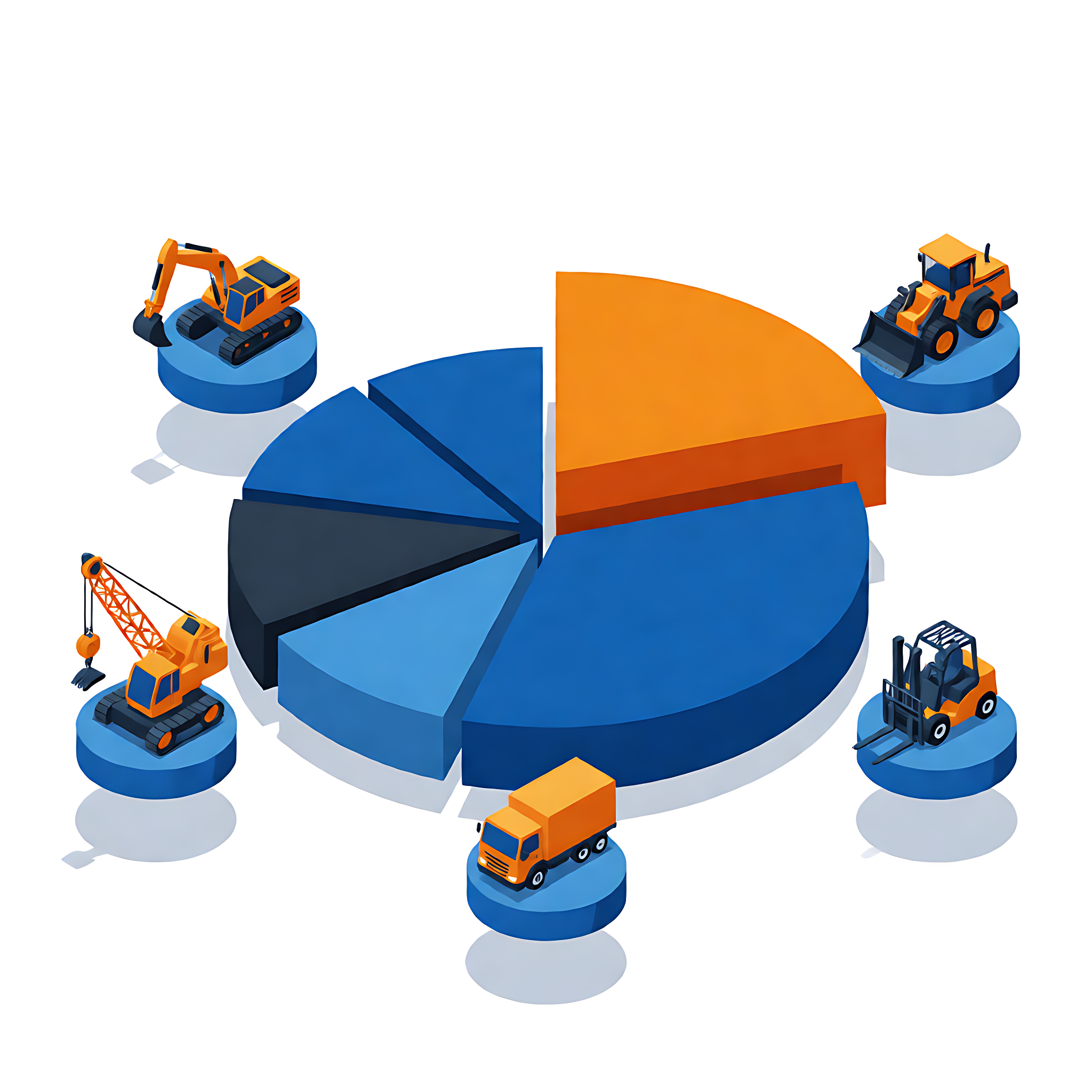
Concentration in this pie is lower than most people assume. GMI's data shows Caterpillar ranked first in the repair and maintenance market in 2025 with a 10.7% share, while the top 5 - Caterpillar, Komatsu, Finning, Hitachi Construction Machinery and Volvo - combined for 29.6%. In other words, more than 70% of the market is scattered across regional service providers, independent repair shops and parts distributors.
By region, the picture changes again. Mature markets are defined by "older equipment plus high labor costs": hiring cycles for heavy-equipment technicians in North America and Europe have stretched to 45-70 days, versus 20-30 days five years ago, and the talent shortage directly caps service capacity. Emerging markets are defined by "equipment growth plus service vacuum": the infrastructure boom in India and Southeast Asia is bringing in large volumes of new machines, but technician density is far below that of mature markets, leaving an even larger service-capability gap.
This is exactly the opportunity window for Chinese brands. LiuGong's global service training director, Huang Guangzhou, told Jiemian News that in 2024 the company's demand for overseas maintenance personnel was growing only 1.5- to 2-fold; by 2026 that had risen to roughly 3-fold, and the company needs to build an overseas repair service team of 800 to 1000 people. Domestically, China's construction equipment fleet exceeded 9 million units by the end of 2025, and the supporting repair ecosystem has already achieved scale. Exporting that domestic service capability to wherever the machines are sold is one of the most certain growth vectors over the next few years. For more detail on Chinese brands' overseas footprints, revisit our deep-water overseas expansion analysis.
Three Shifts Already Under Way
From reactive repair to predictive maintenance. GMI ranks this as the industry's top trend. Remote monitoring systems collect hydraulic pressure, engine temperature, fuel consumption and structural loads in real time - data sufficient to support condition-based intervention. The payoff is quantifiable: versus a run-to-failure model, predictive maintenance can cut unplanned downtime by roughly 30%-45%. Hitachi Construction Machinery's launch of LANDCROS Connect Insight, a remote monitoring and proactive maintenance advisory service, in April 2025 is exactly this logic put into practice.
From selling equipment to selling uptime. Long-term maintenance contracts and billing based on equipment operating hours are rolling out. Such contracts tie the service provider's interests to fleet availability, so parts supply, field response and workshop repair must be strung into a single chain. In November 2025, Komatsu extended its Komatsu West service network to Fresno and Sacramento in Northern California; at the end of that same year, United Rentals expanded its use of Manual Assist AI in service operations, using AI to assist troubleshooting and repair. Whoever has the densest network and the fastest parts can sign the long contracts.
Remanufacturing as the second growth curve. In May 2026, Toromont Industries announced a CAD 55 million remanufacturing center in Saint-Augustin-de-Desmaures, Quebec; the 90,000-square-foot plant will refurbish engines, powertrain and hydraulic components. For owners, remanufactured parts perform close to new at a lower price, making them a practical option for controlling overhaul costs.

Parts and Used Machines: Two Lessons for Buyers
The two parts of the aftermarket closest to buyers are parts and used equipment.
The logic of parts purchasing is straightforward: first distinguish where OEM parts, remanufactured parts and domestic parts each apply. For safety-critical items like undercarriage components and slew rings, do not skimp; for consumables like filters and pins, matching specifications matters more than matching brands. Before buying, get the machine's serial number, hour records and last service date in order - that alone eliminates half the communication cost.
Used equipment is deeper water. In its used-excavator buying guide released in September, Volvo CE listed 10 inspection items, and the core point is one: age can deceive; hours and maintenance records cannot. A five-year-old machine may already be badly worn, while a twelve-year-old machine that has been properly maintained can be the more reliable one. When inspecting used equipment, focus on the manufacture date, actual operating hours, service history and prior application scenario; ask the seller for a cold-start video and recent load-test records, and bring in an independent inspector when necessary. Likewise, safety-related defects - internal hydraulic leakage, cracks in structural members, the condition of the electrical cabinet - must be assessed separately from cosmetic wear. For a systematic look at how repair costs are calculated, see our earlier aftermarket cost-saving ledger.
With utilization rates rebounding, this homework is worth doing. According to data from the China Construction Machinery Association, major products averaged 80.7 hours of operation per month in September 2026, up 3.32% year-on-year and 8.45% month-on-month - equipment utilization intensity is climbing (see our breakdown of September activity data). The busier the machines, the less maintenance can wait.
Final Thoughts
The aftermarket is not an adjunct to the new-machine business; it is a business with its own rhythm. The installed base sets the base level, service radius defines the competitive landscape, and parts and talent set the ceiling. The $54.3 billion pie is on the table; the question has never been whether the pie is big enough, but who can extend their service radius to where the machines actually are.
For evaluation of used-equipment sourcing or parts selection for specific models, feel free to contact our team. EquipNode provides one-stop service covering complete-machine trading, used-equipment inspection and parts supply.