How Excavators Work: Hydraulic Principles, Types and Buying Guide
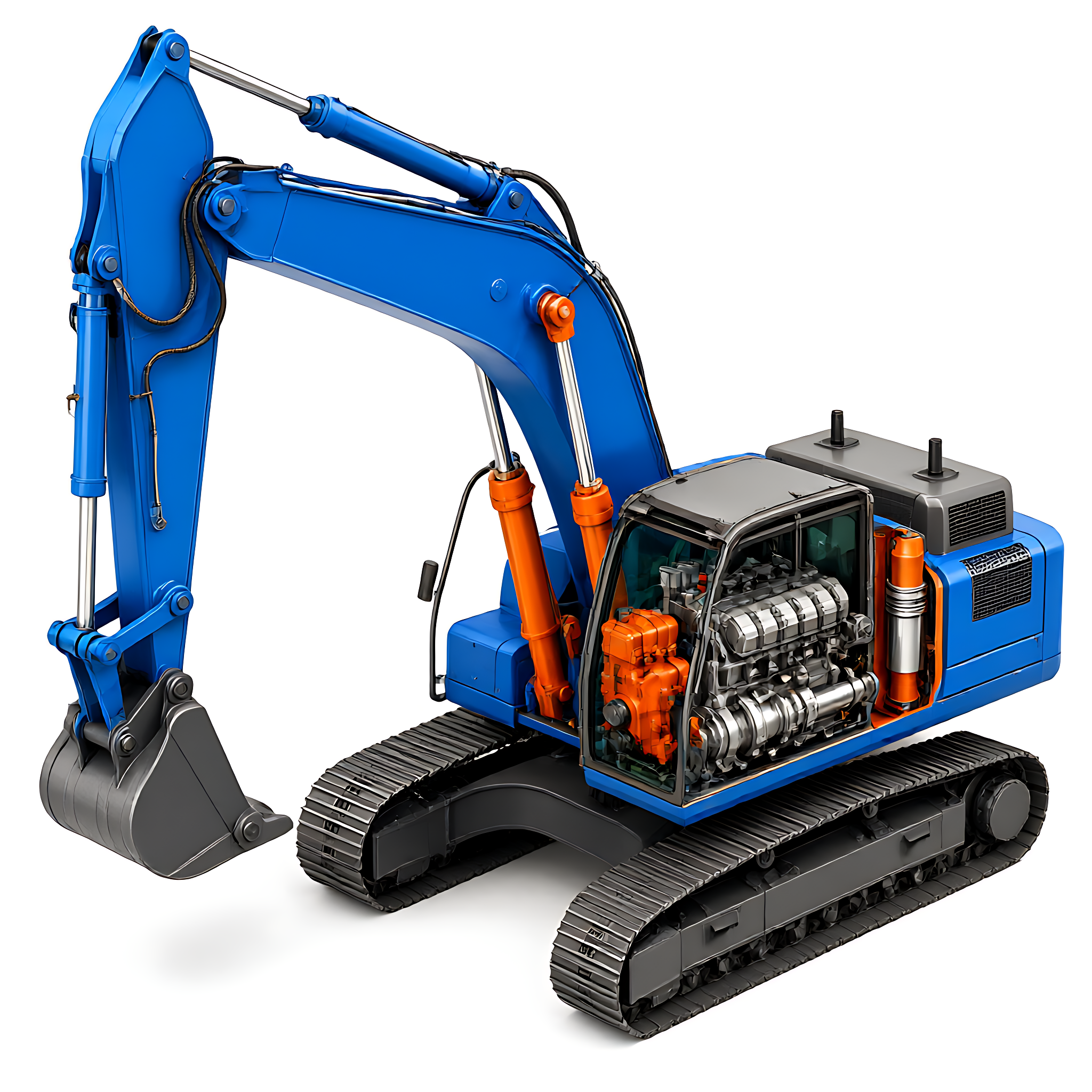
Many newcomers to the industry buy an excavator by asking only about horsepower and price, yet cannot answer the question "how does this machine's power actually reach the bucket?" Without understanding the underlying principles, it is easy to get lost in the spec sheet — and easy to buy the wrong machine. This article explains the excavator's power flow, hydraulic principles, and selection logic in one go.
The Three Main Components of an Excavator
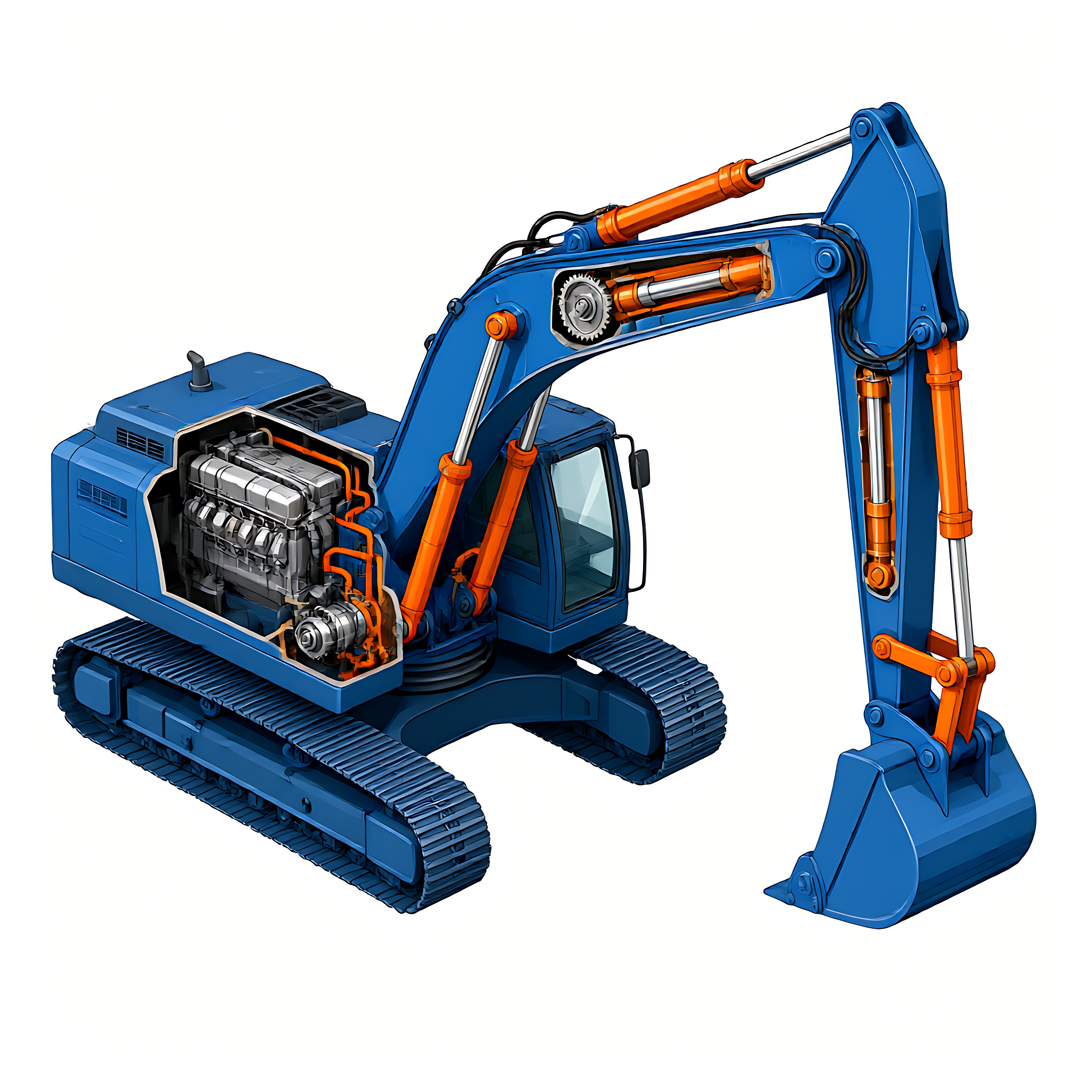
Regardless of operating weight, every hydraulic excavator consists of three major assemblies:
- Power unit: in the vast majority of cases a diesel engine; a small number of applications switch to an electric motor (for example, diesel-to-electric conversion models for fixed operations in mines).
- Powertrain: centered on the hydraulic pump, control valve, hydraulic motors, and cylinders, responsible for "transferring" the engine's power to each function.
- Working equipment: the boom, arm, and bucket together with the rocker and linkage. Backhoe configuration is the mainstream design on the market — it digs below the machine's standing level and handles trenching, pit excavation, and truck loading.
In the undercarriage, the track frame, drive sprocket, idler, track rollers, and track shoes together support the full machine weight and convert rotational power into traction. Between them sits a critical component — the central swivel joint — which allows the travel motors in the undercarriage to continue receiving oil correctly after the upper structure has rotated to any angle.
Hydraulic Principles: How Diesel Power Becomes Bucket Force
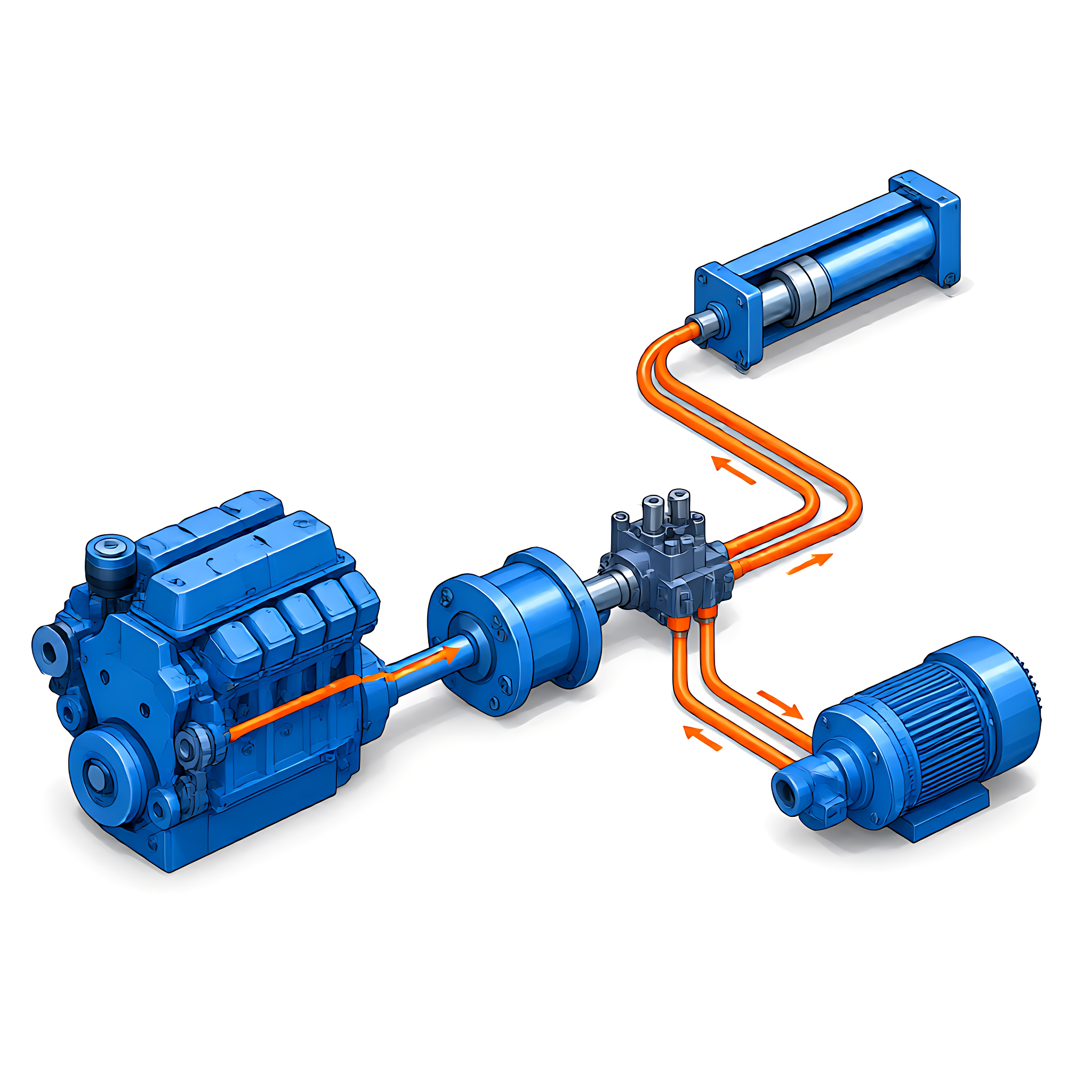
The secret to an excavator's entire power output comes down to one sentence: the diesel engine does only one thing — drive the hydraulic pump; everything else is left to the hydraulic oil.
The complete power transmission path works like this:
Travel: diesel engine → coupling → hydraulic pump (mechanical energy converted to hydraulic energy) → control valve → central swivel joint → travel motor (hydraulic energy converted back to mechanical energy) → reduction gearbox → drive sprocket → track.
Swing: diesel engine → hydraulic pump → control valve → swing motor → reduction gearbox → swing bearing; the upper structure can rotate as long as needed.
Boom / arm / bucket: diesel engine → hydraulic pump → control valve → the corresponding cylinder extends or retracts, driving the working equipment to complete the digging motion.
Most main pumps are axial piston pumps: the engine drives the pump shaft to rotate, and the swash plate converts the rotary motion into the pistons' reciprocating linear motion. Each stroke of a piston delivers a burst of high-pressure oil into the main circuit. One complete working cycle consists of four steps: suction (creating negative pressure), pressurization (piston compression), delivery (high-pressure oil to the cylinders and motors), and pressure relief (the overload valve vents excess oil back to the tank).
The overload valve is typically set at 90%–95% of the pump's maximum rated pressure, acting as the "fuse" of the entire system. When system pressure exceeds the set value, it opens automatically to relieve pressure, protecting the pump housing and lines from damage caused by pressure spikes.
This also explains a common fault symptom: when the machine won't dig and movements feel vague and unresponsive, nine times out of ten it isn't the engine — it's internal leakage in the hydraulic system. Worn pistons, excessive clearance between the valve poppet and seat (normally ≤0.02 mm), and aged seals all let high-pressure oil leak and seep away, and pump efficiency drops directly. That is why experienced operators say the core of excavator maintenance is hydraulic oil cleanliness, not the engine.
Tracked, Wheeled, Mini: The Undercarriage Defines the Application
Although all three are called excavators, the ideal applications for the three undercarriage types are completely different:
- Tracked: low ground pressure, the workhorse for wet ground, soft terrain, and heavy digging conditions. The downside is slow relocation — highway transport requires a trailer.
- Wheeled: fitted with tires, capable of self-propelled relocation; ideal for municipal utility trenching, road excavation, and other jobs with frequent moves. The trade-off is higher ground pressure and slightly reduced digging stability.
- Mini excavator (generally under 6 tonnes): compact, able to access backyards and basements, with low transport cost. The go-to machine for landscaping, farmland improvement, and interior demolition.
The ground pressure calculation is simple: operating weight ÷ total ground contact area. This figure determines whether the machine dares to venture onto soft ground — many jobsite accidents happen when a large excavator forces its way into a paddy field; with insufficient traction, one dig and the machine "digs" itself right in.
One more safety rule: digging force must never exceed the traction between the machine and the ground. When backhoe digging forces the bucket in aggressively, the machine gets dragged forward by the bucket and starts slipping — extremely dangerous. This is why, among machines of the same class, the heavier one often "dares to dig harder."
2026 Market Data: Downsizing Is the Clear Trend
Selection shouldn't just look at the machine — it also has to look at where the industry is heading. A few sets of the latest data:
- MarketsandMarkets expects the global excavator market to reach approximately US$54.49 billion in 2026, growing to US$71.74 billion by 2032, at a CAGR of 4.7%.
- Mini excavators are the faster-growing segment: Persistence Market Research puts the market at approximately US$16.9 billion in 2026, reaching US$24.9 billion by 2033, a CAGR of 5.7% — above the overall market.
- In Future Market Insights' compact equipment definition, mini excavators account for 38% of 2026 demand, while rental companies are the largest end buyers, contributing over 30% of revenue — contractors are increasingly preferring to "rent rather than buy."
- Regionally, Europe is the largest mini excavator market (approximately 34% in 2025), with Asia-Pacific growing fastest. Domestic replacement of the existing fleet is also ramping up in parallel — the industry as a whole has entered a trade-in and replacement cycle. This also explains why [remanufacturing business has clearly picked up over the past two years](blog-news-20261030.html) — the cost advantage of refurbished parts is especially pronounced on smaller machines.
Reading the just-released Q3 reports against this backdrop is also clearer: OEMs tilting profits toward electrified and downsized product lines is not accidental — the demand structure has changed.
Electrification and Intelligence: The Next Variable
Over the past two years, electric excavators have gone from "exhibition pieces" to "products you can actually buy." Compared with diesel engines, electric drive powertrains can cut fuel consumption by 30%–40% (official figures for hybrid configurations), and cases where hundred-ton-class fixed-operation mining equipment saves RMB 2 million per year in fuel after diesel-to-electric conversion are no longer news. For mini machines, electric motors bring a hidden additional benefit: low noise and zero emissions mean they can work indoors and during night-shift hours, effectively doubling the work window.
On the intelligence side, load-sensing hydraulics and variable-displacement pumps with energy recovery have become standard selling points on new models, while GPS-guided precision digging and remote monitoring are also spreading rapidly. When buying a new machine, if the budget allows, it is recommended to at least choose a model with fuel-consumption tracking and remote hour-meter reporting — for owners managing multiple machines, this data is the profit-and-loss statement.
A Four-Step Selection Method
A ready-to-follow process for beginners:
Define the job: tracked for soft ground and heavy digging, wheeled for frequent relocation in municipal work, mini for backyards, interiors, and light work.
Check traction: verify the required digging force against the soil class, and confirm the machine's operating weight is sufficient for stability.
Inspect the hydraulics: prioritize load-sensing systems, and ask clearly about the main pump brand and the overload valve's set pressure.
Compare total cost: the purchase price is only part of it — the replacement intervals for hydraulic oil, filters, and seals, plus the residual value from remanufacturing, must all be factored in.
Choose the right machine and the payback period can differ by nearly half a year. For detailed parameter comparisons and quotations on specific models, feel free to contact our sales team — we provide free selection advice.
EquipNode offers export procurement services for electric loaders and new-energy equipment, covering Southeast Asia, the Middle East, and African markets. Inquiries are welcome.